Optimizing your Google My Business (GMB) listing is crucial for a service-based company to maximize local search visibility, engage potential clients, and drive conversions.
There is no better way to get you piece of your local market with this low-hanging fruit approach.
Here’s a step-by-step guide to help you get the most out of your GMB listing:
Claim & Verify Your Listing
If you haven’t already, claim your business on Google My Business and verify ownership. This process may involve receiving a postcard at your business location with a verification code. This is easy to do and has to be completed in order to get your business listed on google.
Complete Every Section
Business Name: Ensure your business name is consistent across all online listings.
Category: Select the most relevant category for your service. You can choose multiple categories if applicable.
Address: Input your exact address. If you serve customers at their location (like a plumber or electrician), make sure to set your business as a “Service Area Business” and define your service areas.
Hours: Update your operating hours. Include special hours for holidays or events.
Phone Number: Provide a local phone number for better local ranking.
Website: Link to your official website.
Add High-Quality Photos
Showcase your work, team, and office/premises. Regularly update photos to keep the listing fresh. Google has reported that businesses with photos receive 42% more requests for driving directions and 35% more click-throughs to websites.
Optimize the Business Description
Describe your services clearly and concisely, emphasizing what sets your business apart. Utilize relevant keywords without stuffing. Once you finish describing your services, read it out loud to make sure it flows elegantly and doesn’t sound like you are cramming a bunch of top ranking keywords together in incoherent sentences.
Encourage Reviews
Ask satisfied customers to leave positive reviews on your GMB listing.
Respond to all reviews, both positive and negative. This shows prospective customers that you value feedback and are engaged with your clientele.
This is an easy way to out earn your competitors and capture market share.
Answer Questions
The Q&A section allows users to ask and answer questions about your business. Regularly monitor this section and answer queries to ensure accurate information is provided.
Use Google Posts
Share updates, promotions, events, or news about your business. Google Posts appear on your GMB listing and can help engage potential customers.
Add Services & Products
List out all the services and products you offer, with descriptions and prices if possible.
Utilize Messaging (if available)
Google allows some businesses to communicate with customers directly through the GMB listing. This can be an effective way to answer queries or provide quick service.
Analyze & Act on Insights
Google provides insights on how customers found your listing, what actions they took, and where they came from. Regularly review these insights to adjust your GMB strategy and improve visibility.
Utilizing these 10 different actions will be sure to put you in the top 10 service companies in your location and specific industry.
What is the best email marketing tool out there for small businesses and start-ups?
Right now there are dozens of email marketing tools in existence.
If you are looking for a way to grow your email marketing list, ConvertKit may be what you have been looking for all along.
Whether you are a creator with a following, an email marketer, or run an e-commerce store, ConvertKit has you covered.
ConvertKit is a powerful email marketing software that can help you grow your list and improve your conversions.
In this blog post, we will discuss and answer several key questions that many business owners have before investing in this type of software such as:
-What is email marketing?
-What are the benefits of email marketing?
-What do good email marketing campaigns look like?
-What types of businesses can benefit from using email marketing?
-What are the different pricing tiers for ConvertKit?
There are so many more that we could add to the list, but let’s hop in and cover the ones that are provided to get you the best sense of what email marketing can do for your business!
What is email marketing?
Email marketing is a form of digital marketing that uses email to promote products or services.
It is a cost-effective way to reach out to your target audience and can result in increased sales and conversions.
It is arguably the best form of marketing at the time of this writing in terms of an ROI perspective and overall control of your customer messaging.
There are many good email marketing platforms out there.
Email marketing software is wildly lucrative for your company if you know what you are doing.
Most email marketing software companies out there provide great value and a decent price and many even offer a free plan to get started.
Every company charges for its services per month, so rest assured you can get immediate value right from the start.
Let’s move on to the features and benefits of email marketing.
What are the benefits of email marketing?
The benefits of email marketing are vast. When done correctly, email marketing can help you increase brand awareness, drive traffic to your website, improve customer loyalty, and boost your bottom line.
In fact, according to a study by the Direct Marketing Association, email marketers saw an average return on investment (ROI) of $44 for every dollar spent.
As time goes on with email marketing, your investment in time and monetary resources only gets better.
Through A/B testing, a larger database of customer emails, and constant contact, the return from your customers will continue to compound.
If you are capturing your customer’s information effectively on your sign-up forms, your overall number of subscribers will continue to grow and continue to fuel your email marketing services effort.
The best part about email marketing is the marketing automation pieces. Below you will see how this entire process can be done by marketing automation.
What do good email marketing campaigns look like?
Here is an ideal flow of a website visitor into an email subscriber.
Website visitor -> landing page -> sign up forms -> Added to your list -> placed into A B testing emails -> Sold e commerce items or course -> constant contact emails -> Endless buying cycle.
Now that you know what the flow of a website visitor looks like from a 30,000 foot view, let’s talk about how you should think about these in terms of their maximum impact on a customer.
Great email marketing campaigns design a cohesive story around a product or service that flows from one email to the next.
These emails keep the prospective buyer interested in what you have to offer and help entice them into buying.
They generally look and act like a casual conversation with your customers and not a sales pitch.
A great way to judge the email you are writing is by basing its effectiveness on whether it is something that your customer would be excited to open and read in their inbox.
Marketing campaigns should always have clear and concise goals. At the end of the day, your email marketing efforts should be driving meaningful value to your company or brand in the form of monetary value or brand equity.
Creating a campaign like this takes time and effort. It’s not something you can slap together in a few minutes.
Before you pull the trigger on any email marketing software, let me try and make the case to start with software such as ConvertKit.
We have been using this email marketing service for over two years now and we are very happy with our email campaigns and performance.
In terms of lead generation, we have sent endless amounts of emails to our customers that have resulted in thousands of dollars per month.
While on their free trial we initially did an email campaign with our existing customers. Over the next five days, we did a marketing push to get as many 5-star reviews as we could.
In that time frame, we were able to get over 75 – 5 star reviews on Google That was massive value for us as a small business in terms of SEO value and ranking in Google for search.
What types of businesses can benefit from using email marketing?
ConvertKit is best for businesses that want to grow their email marketing list and improve their conversions. It is also a great choice for businesses that want to create automated sequences, tags, and broadcasts.
For that reason, that is pretty much any business that wants to utilize email marketing software to grow their customer base and monetize their subscribers.
If you own any of the following businesses, you should consider email marketing software:
Bloggers and content sites, service-based businesses, newsletters, real estate, e-commerce restaurants, churches, non-profits, etc.
If you are not utilizing email marketing software you are simply missing out on a huge stream of revenue for your business.
Let’s talk about the different features and benefits that an email marketing service such as ConvertKit has to offer.
What are the Benefits and Features of ConvertKit?
There are endless features that ConvertKit has to offer within its email marketing service. Let’s start with the first – Bulk Subscriber upload.
Bulk subscriber upload: If you have an existing list of customers on a CSV form, you can instantly upload these customers into ConvertKit.
Landing Page Creation & Sign up forms: ConvertKit will host any landing pages and sign up forms that you will need to communicate with your web visitors and potential customers.
Saved Email Templates: Instantly create, store, and email out your customers from inside your dashboard.
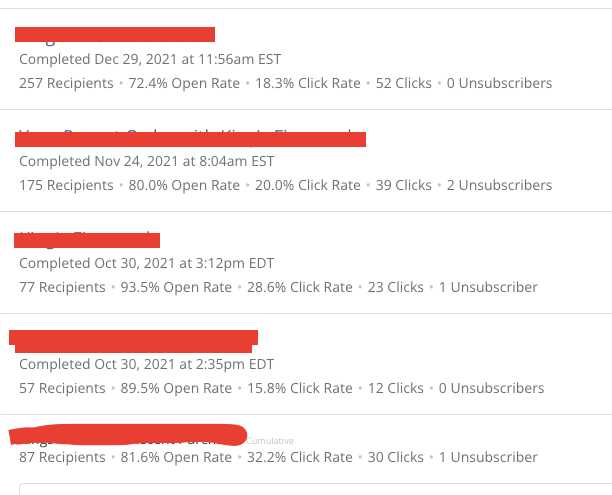
Campaign Monitor: Easily see your past campaigns and the associated metrics for each one. These were highly-targeted segmented emails sent out to our list. Hence the higher open rates.
Email Sequences: Send out a chain of value emails to get your customers engaged and interesting in buying what you have to offer.
This is done best if you can add a sense of urgency hidden within the email. Remember not to be spammy when writing these.
What are the different pricing tiers for ConvertKit?
The best part is how much value you get from ConvertKit. On top of that, it is extremely affordable for small businesses and start-ups. There are three pricing tiers:
– $29/month for up to 1000 subscribers
– $79/month for up to 3000 subscribers
– $379/month for up to 10000 subscribers
Conclusion:
If you are wanting to utilize email marketing to scale up your revenue and your customer base, you can sleep on email marketing software and the associated email marketing tools that come with it.
Marketing automation for any sized business is essential. Almost every email marketing service offers a free trial, so there are absolutely no excuses not to get started!
There are many ways people can grow their email list. One of the most effective is to have a clear, concise call to action on every single page of your website.
Many brands don’t realize that this is one of the easiest and cheapest ways to grow your list!
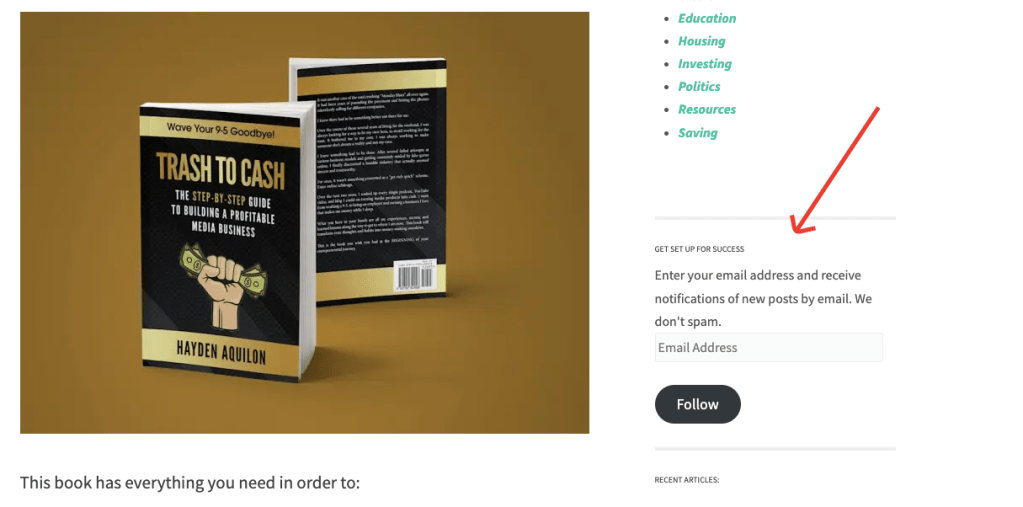
If you’re a blogger, it is great to have a pop up email capture window and you might also want to include a sign-up form in the sidebar of your blog.
To make it as easy as possible for people to subscribe, make sure you only ask them for their email address and nothing else.
The whole key here is to remove any type of friction possible. You just want to get your foot in the door with the visitor. Once you get their email address you can always grow the relationship deeper later on.
If a visitor comes to your site and then promptly leaves, the chances are you will never see that person again.
You should also be creative with how you invite people to subscribe. If you actually want to get email subscribers, you need to peak peoples attention and provide immediately curiosity or perceived value for the potential reader.
Here is a good example and a bad example.
Bad: “Hit the subscribe button to receive our newsletter” (BORING!).
Better: “Smash the subscribe button to get immediate money-making tips for your business.” (There is an actual reason for the reader to subscribe).
Before you want start going your email list you need to get the system in place that will capture your traffic coming to your site.
I highly recommend using something like Opt-in Monster to capture visitors and convert them to email subscribers.
The importance of email list
One of the most important aspects of any business is communicating with your customers.
The easiest way to do this is through email marketing. But what’s the point if you don’t have an email list to send messages to?
Communicating with your customer base is crucial for any company that wants to succeed in today’s market, but building an email list can be difficult and time-consuming. Luckily, you can take steps to grow your email list fast.
Continue reading to learn how!
1. Clear and concise call to action on every page
Having a clear, concise call to action on every page of your website is one of the most effective ways to grow your email list.
As you know, there are many reasons why people aren’t subscribing to your list.
One reason might be because they don’t see it anywhere. That’s why it’s essential to have a clear and concise call to action on every page of your site so that visitors can subscribe whenever they want.
It doesn’t even have to be in the form of a sign-up form; it could just be an easy link with text like “Subscribe” that can open a new landing page.
Get creative and make it a no-brainer to want to subscribe to your list.
2. Bloggers should include a sign-up form in the sidebar
As mentioned, if you’re a blogger, it’s essential to have a sign-up form in your blog’s sidebar. This way, when people are reading any of your blog posts, they can easily subscribe to your list without much effort.
Another idea is to create an eBook or webinar that includes an opt-in offer.
You might want to offer something like a free download of an eBook that provides insider tips on the topic or a free webinar where they can learn more about the topic from you.
To get someone’s email address after they’ve downloaded something from you, have them enter their email address on the thank-you page, and voila! They’re on your list.
3. Including a subscribe button at the end of blog posts
If you’re a blogger, one of the easiest ways to grow your list is by including a subscribe button at the end of your blog posts.
Whenever someone finishes reading your post, they should easily subscribe to your blog. This is also an easy way for people who want to know more about your business without clicking through to another page.
4. Including an email list box at the top of pages
Include a sign-up box at the top of your page so people can subscribe right away. This will allow a person to subscribe before they even read your content.
5. Including an email list box at the bottom of pages
If you’re an online business and you want to grow your email list, you can include a box at the bottom of every page on your site that asks people to subscribe. The box should be straightforward and should only ask for an email address.
6. Offer an Incentive to sign up
You can offer a free download or another incentive in exchange for an email address and then use the contact information you gather to promote future content.
Consider using this to grow your email list. It’s also important to collect emails and make sure that people opt in because there is no point in building up an extensive list of contacts who may never open any messages from you.
Free ebook down loads or a PDF of useful tips tend to work very well for this.
7. Use Social Media
The more followers you have, the easier it is to convert them into email subscribers. You can use social media platforms such as Instagram and Facebook to grow your following base.
Post a link in the caption of an Instagram story or post with a call-to-action that tells people how many new emails they’ll receive for signing up for your company’s mailing list.
Also convey to them what the value will be by doing so. Are there any success stories from your readers or video reviews you could use?
Another way you could increase engagement on these channels is by posting content that will resonate with this audience while still providing some value to those who are already following along on social media accounts like Twitter and LinkedIn.
8. Turn any press mentions into an opportunity to grow your email list
One of the best ways to grow your email list is by using press coverage. If you have been mentioned in a local paper, blog post, or other media outlet, then this can be used as an opportunity to add new subscribers and followers to that article.
You should include links at the bottom of any articles about your business so people who might not know much about it will learn more and potentially subscribe for updates on what’s happening with you.
This also helps build credibility because they’ll see how many others are following along, and if there are comments left below, these could even provide some great ideas for future content!
In addition, think about how bad you would feel if someone blogged and linked to your site that had a huge following and you ended up having nothing in place to capture some of these visitors – ouch!
9. Include customer reviews on your sign-up landing pages
Reviews can be a powerful tool for increasing conversion rates on your website. Reviews provide social proof that others have had positive experiences with your company and products, making potential customers feel more confident about their purchase decision.
This is especially important when it comes to an email subscription. Consumers likely will want to learn more if they believe others had a positive experience with your company.
Consider placing an area to subscribe to your email list below the positive reviews.
10. Create a blog that users can subscribe to
A compelling blog can be a great way to draw in interest and allow people the chance to subscribe.
There are many ways you could do this, such as through social media, email marketing, or even just by word of mouth.
If your company is new and has not been around for long, it might make sense to start with an introduction post that tells potential customers what they offer and why their product or service would benefit them.
You should also include some pictures, so readers get a better idea of who you are!
11. Post about your newsletter
You can also post your email newsletter to social media to generate more subscribers.
This is an excellent way to drum up interest for people who are not yet subscribed to your email list but are looking for the next step in the relationship.
You can do this by posting links or images that link back into your blog posts with the title of the article and an excerpt from it. For example: “Click here if you want learn more about ____”.
12. Promote content that requires users to subscribe to view
Another great way to get more email subscribers is to generate content that you can only view via your emails.
You can use this technique by creating content that includes videos or images that will not be available anywhere else on the internet.
This type of exclusive content encourages people who would never sign up for something online to sign up so that they can see what’s going on with your business.
13. Give Away Useful Products or Services
One of the best ways to gain email subscribers is by giving away products or services that your audience will find helpful.
You can set up a competition with prizes to gain more readers. You can also offer free consultations for your skills.
Giving away these types of helpful products or services will make people want to sign up for your email list because they know they’ll be getting something out of it!
14. Paid Services or Classes.
Paid services or classes are a great way to gain email subscribers for your blog. Paid services and classes give potential customers a better understanding of what your business offers and can even provide a free trial to help them decide if they want to use the service or purchase the product.
During the free trial part you want them to be flooded with value so that they see the immediate value in your product or service.
The best part is that you don’t need to worry about customer acquisition costs because you’re paying for them yourself.
Conclusion
Marketing for your company or organization can be challenging when you start. Still, by being proactive and creating many ways for consumers to subscribe to your email list, you set your business up for long-term success.
Apply these tips to grow your email list and watch your company expand!
Happy Hunting!
Want more in-depth tips to scale your business fast and profitably? Smash that subscribe button below!
Look, Starting and growing a small business is hard enough as is.
You don’t need to add any additional layers of stress in your life by not systematizing and organizing all your customers, sales, and interactions in one place.
If you want to get serious about your company’s future and growth, it’s time to throw away the note pads with customer’s phone numbers you can hardly read and the outdated paper invoices and folders.
You know who you are! I’m talking to the guy who has all his receipts, customer phone numbers, and invoices thrown on the dashboard of the truck.
You basically look like a homeless person sleeping in your car – not a good look. Let’s change that!
You need to understand that the list of simplicity that using a CRM affords you is a long one, and very valuable.
So what exactly is a CRM? A CRM (Customer Relationship Management) is an automated system used to manage all aspects of the relationship with a customer.
CRMs are generally designed to help track, organize and analyze all interactions between an organization and its customers.
CRMs provide businesses with detailed information about their customers’ history so they can personalize future messages, target promotions, and design customized products.
Many CRMs also include software that helps you recognize which customers are most profitable, how loyal your best customers are, which marketing or advertising campaigns produce results, whether or not your employees follow up consistently with every customer — plus lots more.
There’s no doubt that CRMs can save business owners valuable time by keeping them organized and up-to-date on a company’s sales activity and customer demands.
CRMs also save money by helping to identify and track the best customers, rewarding them with speedy service and profitable deals. CRMs are extremely effective tools for small businesses as well as large corporations.
CRM software provides you with a central place to manage your contacts, schedule appointments, make notes about follow-up activities, share files, and even send email or text messages directly from the CRM.
Most CRM software has calendars that let you view all of your meetings, deadlines, and tasks in one place so you can easily prioritize what needs your attention right now.
Not sure where to start?
First, you need to understand that there are many CRM’s out there in the marketplace that serve all different types/sizes of clients.
If you are a small business owner or entrepreneur doing between $0-$1,000,000 in revenue. Monday.com could be your best bet – so read on.
Monday.com CRM
Monday.com takes just minutes to get going!
The image above is an actual shot from our own CRM. We have removed certain columns for customer’s privacy as well as a few other key metrics.
This is fully customizable, and it’s as easy to use as a spreadsheet!
If you are looking for a CRM that will grow with you & your team, Monday.com has the perfect CRM package for your business.
They understand that every company is different so they built their CRM with customization in mind.
The best part is, you do not need to have any programmers or developers in your back pocket to build this out for you or make changes.
Monday.com CRM is ideal for small businesses that want to manage and track their leads. It’s also great for businesses who want to collaborate with their team on projects in real-time.
Monday CRM is cloud-based, so it’s easy to access from anywhere. It also integrates with other popular applications, such as Google Apps and Salesforce.com.
For those of you that are unfamiliar with cloud-based solutions. Here is a run-down for you, as it is important to understand.
Cloud-based technology refers to the ability to access and use information or applications over the Internet. This means that instead of having software installed on your computer, you can access it, or store it, on a remote server.
Examples of this technology include consumer services such as Dropbox, Google Docs, and Microsoft Office 365.
You can easily build workflows by integrating Monday with your favorite apps like Slack or Google Drive. Monday also has integrations with Gmail, Salesforce, Quickbooks Online, Outlook & more.
If you are looking for a CRM solution that was made specifically for teamwork inside of sales teams and other orgs within your company, then this is the CRM you should be looking into.
They also provide a mobile app, so you can access your information on the go. Finally, Monday has a built-in reporting feature to help you analyze data and make informed decisions for your business.
This part is actually my favorite part about the service. Having access to the mobile app saved us many times over by being able to do quick customer look-ups on the road, re-routing our drivers at a moment’s notice, and double-checking if order payments were complete.
User Interface/User Experience.
The Monday.com user interface is intuitive and easy to use, as well as visually pleasing with simple navigation, that enables users to easily see existing projects or new tasks.
One of the features that I liked most was the communication log which makes it convenient for businesses that have more than one person handling communication.
Communication Updates are easy and efficient.
Oftentimes, tasks can be duplicated which can lead to several issues along the way. This is especially true for sales leads that are coming in.
On multiple occasions, there can be double communication to clients on delivery times or order confirmations.
Even worse, one rep could be telling a client one price, and later a second rep could be reaching out saying a separate price. This is common with service-based business transactions.
It also stops more than one rep “working” an account, to avoid further confusion and potential issues with crediting a certain rep to a sale. This is due to all conversations and data being time-stamped within the app.
In addition, you are able to see a full communication history that the team members are having by double-checking their conversations that are compiled in a single thread.
That way, you are able to provide more efficient feedback and correctly prioritize requests from clients based on the overall conversation.
What is the Price Range?
Monday.com pricing depends on many factors.
To start out, they do have free plans for small businesses. The service is easy to use and can be customized to fit the needs of any business.
The free plan includes all of the features of the paid plans, so businesses can get started quickly and easily without having to worry about finances.
The pricing of monday.com is going to depend on the company size since they base the amount you pay on the number of seats your company needs.
As you can see below in the photo each price is based per seat. Most small businesses have between 1-10 employees.
One thing to mention. The smallest amount of seats you can have is 3, even if you don’t have 3 employees.
Depending on that you are looking at between $24-$80/month depending on your team size. I can’t begin to tell you how worth it this is for you to utilize.
Monday.com has worked great for our small business and it can for you too!
Happy Hunting!
Want more in-depth tips to scale your business fast and profitably? Smash that subscribe button below!
Jen Lauren is a “nano” influencer on Instagram and YouTube
What are they? And more importantly – why are they important for your business?
For many of you, Instagram influencers may not be worth the investment in the first place. The strategic use of Instagram influencers will be unique to every business.
But before you write them off. There is a possibility it could be a great fit for your particular business. After all, spending money with influencers can be cost effective if done right.
On top of that, it can be completely trackable if the proper steps are taken.
Let’s start by looking at a mediocre/bad example of how NOT to use an Instagram influencer first.
How NOT to Use Instagram Influencers.
Let’s say that you own a pool cleaning business in a certain city in the US. You hear from your friends how well they are doing from using Instagram influencers, so you decide to go out and look for one that will help your business.
You find a guy that puts out pool related content in terms of pool maintenance, care, and best practices. He is funny and clever and he has close to 10,000 followers on Instagram.
He puts out good content and keeps his videos and posts captivating – who knew someone could make pool cleaning so entertaining!
This could be the guy, you think. He almost has 10,000 followers – that could be good for my business.
Shortly after, you decide to message him direct and you agree on a monthly amount you will pay him to promote your business. You have high hopes and can’t wait to watch the money roll in.
The problem is that it never does – let’s unpack why.
Market fit – geographic inefficiency. This influencer has an audience that is mostly nationwide, with some even out of the country. This will not benefit you at all, since your business is a local service-based business.
Wrong audience. Just because this individual has followers looking at his page about pool cleaning, it doesn’t necessarily mean that they are all your dream avatar in terms of an ideal customer. Many could just be there for the good humor that he has. In addition, there are likely to be other pool cleaning company owners following that individual for the entertainment and potential tips.
Method of compensation. It would have been a smart idea to test out the influencers audience ROI by doing a couple pay per posts to start off. In the short run it would cost you less and you could get feedback immediately.
A more realistic scenario to use this influencer would be someone who owned an online pool supply company and only did e-commerce. Even then, your conversion would be questionable.
Now let’s jump ahead to how to make this work for your business using instagram influencers.
A Better Way to Use Instagram Influencers.
Let’s say that you owned an e-commerce brand that sold nursing pillows and other products to strictly pregnant and new moms.
You spend hours looking for moms that have decent size followings (but not huge) on instagram and youtube. You finally find one youtuber who happens to have an instagram account as well, with around 10,000 followers.
As luck would have it, she also has a blog along with her other social media channels. You get to talking and let her know you would be willing to partner up and do paid affiliate ads with her.
Ilana Wiles – One of the top Mommy Influencers.
She is very interested, and happily shows you her audience insights on her different platforms. Her audience is perfect for you. 95% mothers who are all either pregnant or with a baby.
You see that on all her posts there is a TON of engagement. Likes, comments, shares, etc. You know there is serious opportunity there.
You decide to set up a deal where she promotes your website with a unique coupon code that is solely unique to her and her audience.
From there the sky’s the limit and its a true win-win. If her audience is engaged and trusts the influencer, there should be a great turn out on her promotions.
That will net you and the influencer good money, and you both would be excited to continue working together.
Conclusion…
In summary, we thought it would be appropriate to end with a pro and con chart as it relates to influencers.
PROS
-Access to an engaged audience -Can be cost-effective -flexible Pricing -Able to scale up your business much quicker
CONS
-Could take multiple paid influencer trials until you find a good ROI. -The effectiveness of IG promotion may be on the decline.
Want more in-depth tips to scale your business fast and profitably? Smash that subscribe button below!
We all want the growth hack that will take our existing business and shoot it to the moon. “Growth levers” is a term I constantly hear coming from the online world. I like that saying, don’t you?
Let’s unpack the quickest way to pull these growth levers so that we can scale your business as fast as possible.
The 5 Questions to Ask Yourself That Will help you grow and scale your business.
Let’s go over these 5 questions so that you can achieve growth and scale for your business. These apply to both new businesses and small business.
1. Should I do Homework or Planning Before Starting A Business?
The obvious answer is YES. Make sure to take a good look below at the following questions to determine if what you are doing is likely to be worth your time and investment. These are just a couple examples.
Are there enough customers?
Can this company scale quickly and efficiently?
Can I charge enough for my product to afford ads and fulfillment?
How is my timing of a launch?
Should I partner or not?
These are just some of the many things you need to be thinking about and evaluating as you are doing your homework.
The list is endless of people who never do their homework in the beginning and are destine to fail from day one. Don’t be one of them!
2. Should I bootstrap my Business or Raise Money?
That depends on your desired outcome.
Do you want to be a founder that is in charge of a large team, lots of responsibility, and fast growth? Then you may want to raise money.
That money will help amplify the following:
Increase the number of leads from advertising dollars.
Afford to hire a great team from the get-go.
Launch with a large amount of SKUs (if you are a product-based company)
Start off with a bang in your sales numbers due to large Ad budget and customer service in place.
On the other hand, if you want to boot strap you will be choosing to take the safer and longer path to growth (in most cases).
Boot-strapping a business will look like this:
Could be months or years until your product gets traction from building a customer base and low ad budgets.
Potentially less stress as less people are depending on your for leadership and a paycheck.
In most cases you will use your own money. Many founders claim they had to max out their credit cards to get going.
Going this route you really have control over which direction you want to take and you are not forced by a board or shareholders pressuring you to make the next move.
Between bootstrapping and raising money, I think the answer is clear – Raising money will allow you to grow and scale the fastest. But be careful.
3. Do I Need Systems and Technology In Place to Scale Fast?
More often then not, the answer is almost always yes. This is in both product based business and service based businesses.
If you start to grow and scale, that means your sales numbers are going up (naturally). If you have not put teams in place to handle the influx in sales, you will have a disaster on your hands.
Bad reviews, wasted ad dollars, upset customers and closing your doors from terrible cash flow could destroy you immediately.
Here is what you need to have in place before you are ready to pull on a growth lever for sales.
Customer service team.
Sales team Inbound and outboard (most likely).
Fulfillment whether that be ecommerce or service based. Someone has to fill the packages and go on service calls.
ERP system to effectively track all aspects of your business. Leads, orders, deliveries, SOPS, financials, invoicing, you name it.
*These are just a few and can cost you a TON.
4. Do I Need To Build a Team Beforehand or Can I Hire as I go?
Waiting to hire a team after you open the flood gates would be a complete disaster waiting to happen.
You need to get a team in place immediately that is skilled enough to handle the new requirements that are suddenly being placed on your and your business.
In order to hire effectively, you need a system and process for finding the right talent, interviewing them, and on-boarding them so they are ready to rock.
With that being said, you don’t always have to put the burden on hiring a team on yourself. You can look to outsource things like marketing and sales to other agencies that don’t need a hand-holding.
5. Where Is the Best Place to Get Leads For My Business?
That all depends on what your business is. Clearly there is no one-size-fits-all in this loaded question.
Here is a good rule of thumb to think about when it comes to service-based businesses vs. Product-based businesses.
Examples of Service-based businesses:
Pool cleaning
Christmas lighting
Firewood delivery
Power washing
Waste management
gyms
For these types of businesses we have found that google advertising and local paper, magazine, and mailers tend to work best. Also a good referral system in place is a huge asset you need to get implemented ASAP.
Examples of Product- Based Businesses:
Ecommerce
Retail Stores
Grocery
Thrift Stores
Dealerships
For these types of businesses there are so many options to go with. Google works great, Facebook, Instagram, influencer marketing, road signage are just a few. For each type of business listed above, you are almost certainly going to have a different blend of marketing channels.
Ex) Dealerships do well with word of mouth and referrals. Ecommerce can do well with google, Instagram, meta and influencer marketing.
It is up to you to get testing and figure out what channel will work best for your business. Good luck out there!






 scalecustomers.com