
This is something I personally have experience with. It turns out that the path I ended up taking turned out to be a pretty good one. The growth was steady, I didn’t have many setbacks, and the risk was minimal. I suggest you try going a similar route that I did.
Below I noted for each of you where I was in my journey, as well as the associated sales numbers to give you the clearest picture of each transition.

CHERRY-PICKING BOOKS
“Cherry-Picking” books means simply going out and buying books individually, at various locations where you can actually see the value of the books before you buy them.
In the beginning, all you need to focus on is cherry-picking books at places like garage sales, thrift stores, libraries, etc.
The best way to do this is always by getting on google maps and searching up something like “thrift stores near me”.
While you are doing this, you are going to want to start making contacts with managers of these stores. Over time, you will most likely be able to cultivate these relationships into larger lead sources when you have space to take on more inventory.
It’s not uncommon to find a local thrift store that can start giving you a pallet or two a week of their overflow product. At this stage, your overhead is going to be extremely low.
You will be doing everything out of your garage or office, and hopefully be keeping a clean working space.
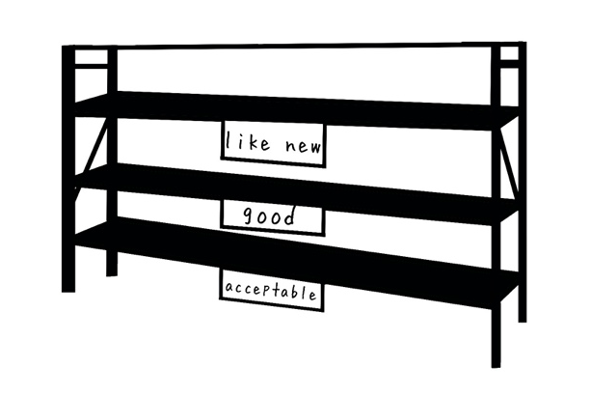
I recommend buying shelving or a rack like this one to the right at Home Depot. It is super durable and needs to be able to hold over 1,000 lbs.
Throw some cardboard on the top of each rack so it does not indent your books.
Each rack will hold different types of book conditions. Lowest quality will be labeled “acceptable”, middle quality is “good” and top quality is “like new”.
You will be sending all your books to be fulfilled by Amazon. This is also known as FBA. That means that the minute you can ship out a box of books, you want to get it shipped out and out of the way.
Don’t let books pile up. Remember, when inventory is sitting unprocessed it’s costing you money.
Keep at this until your sales get to $5,000-$10,000 a month. I would recommend getting closer to $10,000.
From here you will start to get some traction and want to start looking into more of a hybrid model.
HYBRID MODEL
At the $10,000 mark you will most likely start to see some sort or resistance or flattening of your sales if you stay with the current model of cherry-picking. Most of this is due to the maximum leverage of your time. You only have so many hours in the day. In addition, your local sources may start to get exhausted.
This is when you need to start thinking about how to maximize your time. This is when you need to use leverage to get your hands on a lot of product.
At this point, you are going to want to incorporate library sales, estate sales, and lead generation for larger book removals on places like Craigslist and Facebook marketplace.
Some of you may be wondering why you wouldn’t just start out by doing this in the first place and skipping cherry-picking all together.
I believe it is of absolute importance to get your “reps in”. You need to understand the software over time. You need to get a feel for what sells well and what doesn’t. You need to get your scanning and listing methods down. There is no reason to rush through all this – it’s a short amount of time and the learning curve isn’t steep. Don’t worry, you’ll get there.
Before jumping from your garage or storage unit into a warehouse, I recommend that you are doing at least $20,000 a month in sales using this model.
The 50/50 Model
You want to be able to use your existing cash-flow to fund as much of the operations in your new warehouse as possible. Do not keep piling unnecessary overhead onto your business.
This is when you are going to start using some of the contacts of the managers you have gathered from some of your thrifting/library locations.
Do they have location distribution centers where they store excess inventory to sell by the pound? What do the libraries do with all their excess materials? Who is the best person for me to call to set something up?
You will be buying larger volumes of books, sight unseen for the most part since you are buying them by the pound. You will be buying off liquidation sites, government education sites, etc. These will be named for you later.
Hopefully you own a larger SUV, since this will really come in handy at this point. For others, you will be renting a 16-foot box truck for most of your pick-ups.
When you get to the $20,000+ mark, you are again going to realize that scaling to the next level is going to be hard unless you make another transition in your business model.
The way I like to think of the shift is like this – Up until this point, you have gone to get all the books yourself.
You drove all of over town to all the thrift stores. You traveled far to library sales and maybe estate sales. You went and picked up larger book lots from your leads off of several marketplaces.
You made trips to liquidation centers and school district overflow distribution centers. Boy, it gets exhausting.
However, it’s time to get all the books to come to YOU. This is the major shift. This is when you start buying bulk books by the pallet. Although this initially feels great and you get to drive less, your overhead will start to creep up on you.
Bulk Books
This is when your warehouse costs start and your constant purchase of large amounts of books (book burn) kicks in.
At this point, I easily spend up to $5,400 a week on books. For many of you that may be your cost for books for the first four months or more in the beginning.
What you are going to quickly realize is that you are going to immediately take home less profit the minute you transition into a warehouse. That is because initially your top line (sales) will stay the same, and your bottom line (profits), will take a nose dive.
Do not freak out when this happens as it is natural with any business as you scale up. Soon after you make the transition, you will start to see the fruits of your labor, as long as you are consistent. There is always a lag time to see the benefits of the effort you are putting in today.
I always say that the work you put in today, you won’t see reflecting in your sales at least 30 days from now. Conversely, the sales you are seeing today, are a result of what you did 30 days ago.
I recently got off a phone call with a gentleman that I mentor that was frustrated by what little progress he was seeing for that day in his seller app.
He told me how hard he had been working all week and how many books he was able to source and list. I already knew what the problem was right from the get-go.
“Didn’t you have 0 employees a month ago? Wasn’t this around the time you were hardly working? Remember that trip you went on?”
He had not been consistent what-so-ever in the past 30 days and it was showing. Even though he was working hard the last couple days, how could that effort be evident yet in his numbers?
The work he is doing now, pays off later. Point being, you must always be consistent with sending in product. It’s a numbers game.
Once you have a warehouse you should have at least three types book source funnels.
1. Bulk books by the pound from large vendors.
2. Inbound lead generation from your own website.
3. Local pick-ups or drop offs from mom-and-pop stores.
Now that you have a snap shot of what my path looked like and your interested in this opportunity, I invite you to get my book for a more in depth look at this opportunity!
You can check it out on amazon.com —> here. Enjoy!
Want more in-depth tips to scale your business fast and profitably? Smash that subscribe button below!
 scalecustomers.com